
The Serpentine Valley is a strategic card game based on real snake species from around the world. Each card is created by giving the species unique characteristics, abilities, attacks, illustrations and realistic stats.
Card Design:
To begin with, first familiarise yourself with the card layout. Each card contains the following features:
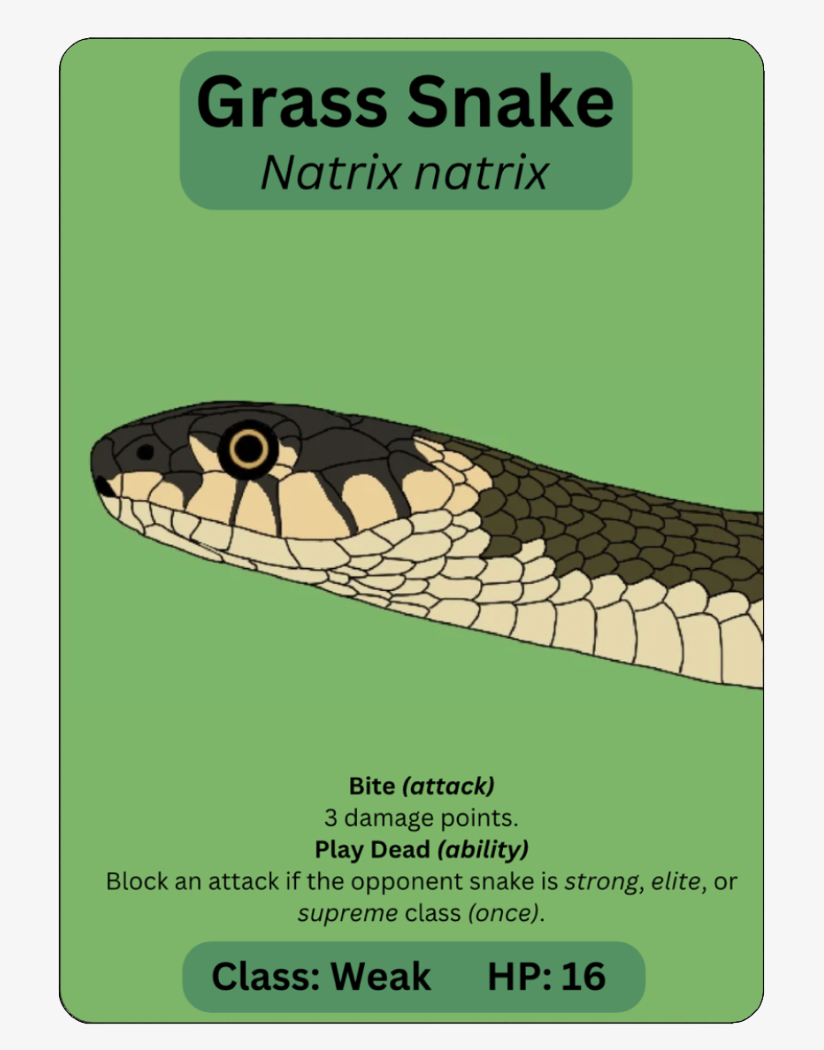
- Common name and scientific name: At the top of the card there is the name of the species in English and underneath in smaller text the Latin name for clear and easy identification.
- Illustration: A detailed hand-drawn image of the snake is positioned in the centre of the card
- Attacks: Below the Illustration you will find the snakes attacks, some have one, others have multiple. The overall damage of each attack is displayed at the start and specifics are show later.
- Class and HP: At the bottom of the card both the class and HP (health points) are presented. The class gives and idea of how strong the snake is, or how ‘good’ the card is, ranging from: Weak, Mediocre, Strong, Elite and Supreme. The HP is determined on real characteristics of the snakes such as length and weight.
- Abilities: Not all snakes have special abilities, however some are unique. They function in one of two ways: 1) They are always active regardless of your place in the turn cycle and their ability works throughout the game 2) They are automatically active until used; they do not have to be initiated but once they are selected, the same ability cannot be used during the same game. This is marked with a ‘(once)’
Game Rules:
Once you understand these features you can prepare to play the game. First create a deck of 10 cards by choosing your strongest or favourite cards. (If you and your opponent agree on a different amount of cards which the deck should consist of, it won’t affect the game in any way other than duration.) Then you can find an opponent to play against.
The game functions on a turn based system. First agree which player begins first and gets the advantage. Assuming you get the first turn, you will draw 1 card. In one turn, one attack can be selected which will have an effect on your opponent’s card. Once a card has been drawn and an attack has been selected, your opponent can draw a card as a response. This card takes the damage and can then play one attack after assuming it has survived the first attack.
This continues back and forth until one card is defeated. The player who lost the card sets it aside until the end of the game, and then draws another from their deck making it their turn again (regardless of the previous turn order). Then the same cycle begins.
The game ends when all cards are defeated but one, the player who has the last surviving card wins the game. The stakes / rewards for winning the game are up to the players to decide.